SUMMARY
Commercial HVAC repair vs replacement is not always a simple decision. For NYC property managers and facility teams, the right answer depends on equipment age, reliability, energy performance, repair history, tenant needs, operating risk, and long-term building goals. In this blog, we explain how Donnelly Mechanical helps commercial buildings evaluate whether equipment should be repaired, retrofitted, or replaced before small problems become larger disruptions.
When Should a Commercial HVAC System Be Repaired vs. Replaced?
Commercial HVAC systems are essential to building performance. They support tenant comfort, indoor air quality, daily operations, and energy use across commercial properties. When equipment starts failing, facility teams often face a difficult question: should the system be repaired, retrofitted, or replaced?
At Donnelly Mechanical, we help building owners, property managers, and facility teams make that decision with a clear view of the equipment, building needs, repair history, operating costs, and long-term performance goals. Commercial HVAC repair vs replacement should never be based on guesswork. It should be based on what the system is telling us and what the building needs moving forward.
In New York City, this decision is especially important. Buildings face heavy operating demands, tenant expectations, energy performance requirements, and complex mechanical systems. A repair may solve the immediate issue, but replacement or retrofit may be the better long-term decision if failures are recurring, efficiency is declining, or the equipment no longer fits the building.
CONDUCTING HVAC SYSTEM ANALYSIS: A COMPREHENSIVE GUIDE
Why the repair vs. replacement decision matters
A commercial HVAC system failure can disrupt more than comfort. It can affect tenant satisfaction, business operations, indoor conditions, energy use, and facility team workload. When repairs become frequent or unpredictable, the building may spend more time reacting to problems than planning for performance.
That does not mean replacement is always the right answer. Some equipment can be repaired effectively, especially when the issue is isolated, the system is otherwise reliable, and the repair supports continued operation. In other cases, repeated repairs can become expensive without solving the deeper problem.
ASHRAE Standard 180 establishes minimum inspection and maintenance requirements intended to preserve a commercial HVAC system’s ability to support acceptable thermal comfort, energy efficiency, and indoor air quality. That standard reinforces an important point for facility teams: maintenance and system evaluation are part of protecting long-term performance, not just responding when something breaks.
Start with equipment age and condition
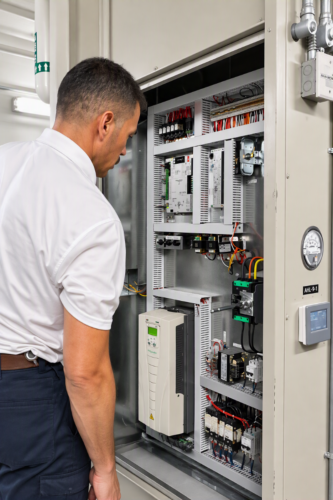 Age is one of the first factors to consider, but it should not be the only factor. An older unit that has been well maintained may still perform reliably, while a newer unit with poor maintenance history or operating stress may have repeated problems.
When we evaluate equipment, we look at the condition, not just the installation date. That includes wear on major components, coil condition, motor performance, refrigerant or hydronic issues, controls, vibration, corrosion, leaks, airflow, and service history.
A repair may make sense when the equipment is in generally good condition and the issue is limited to a specific component. Replacement may become more practical when major components are failing, parts are difficult to source, or the system is nearing the end of its useful service life and no longer performs reliably.
The goal is to understand whether the repair restores dependable operation or simply delays another failure.
Look at repair frequency and reliability
Recurring repairs are one of the clearest signs that a commercial HVAC system needs a deeper review. A single repair may be manageable. Repeated calls for the same unit, same zone, or same type of failure may point to a larger system issue.
Facility teams should pay attention to patterns such as:
- Repeated compressor, fan, motor, pump, or control failures
- Frequent comfort complaints in the same area
- Short cycling or inconsistent operation
- Rising emergency repair calls
- Parts being replaced more often than expected
- Equipment that requires constant adjustment to stay operational
When reliability declines, the cost of repairs is only part of the problem. Facility teams also have to consider downtime, tenant disruption, after-hours service, staff time, and the risk of failure during peak heating or cooling demand.
At Donnelly Mechanical, we look at repair history and system behavior together. That helps us determine whether the best next step is repair, retrofit, or replacement.
Evaluate efficiency and operating costs
An HVAC system can still run while costing more than it should. Declining efficiency may show up through higher energy use, longer run times, inconsistent setpoints, poor controls response, or equipment that struggles to meet demand.
ENERGY STAR recommends improving operations and maintenance practices by regularly checking and maintaining equipment to ensure it functions efficiently, and it also recommends annual HVAC tune-ups through a maintenance contract. For commercial buildings, those practices can help facility teams identify whether equipment is operating as intended or becoming a cost burden.
Repair may be the right choice when a specific issue is causing inefficiency and can be corrected. Replacement may be worth considering when the system is outdated, inefficient by design, or no longer capable of meeting the building’s needs without excessive energy use.
In NYC, efficiency is not only about monthly utility costs. It is also connected to broader building performance goals, sustainability planning, and emissions requirements.
WHY BUILDING MANAGEMENT SYSTEMS ARE IMPORTANT FOR HVAC
Consider whether a retrofit can solve the issue
Commercial HVAC repair vs replacement is not always a two-option decision. In some buildings, retrofit may be the smarter middle path.
A retrofit can involve upgrading controls, replacing specific components, improving ventilation performance, adding variable frequency drives, modifying piping or ductwork, improving sensors, or modernizing parts of the system without replacing everything. This approach may help extend equipment life, improve efficiency, and reduce comfort issues when the core system still has value.
Retrofit may be worth considering when:
- The system structure is still sound
- Major equipment is not ready for full replacement
- Controls are outdated or unreliable
- Building use has changed since the original installation
- Energy performance needs improvement
- Budget or phasing requires a staged approach
A retrofit should still be based on a clear assessment. If the system has severe mechanical issues, repeated failures, or poor compatibility with future building needs, replacement may provide a better long-term outcome.
Factor in tenant comfort and building use
Commercial buildings change over time. A system designed for one type of occupancy may not perform well after renovations, tenant changes, new schedules, higher internal loads, or different ventilation needs.
For property managers, tenant comfort is often one of the strongest indicators that equipment needs attention. Hot and cold calls, humidity complaints, poor airflow, and inconsistent temperatures can all point to HVAC problems. Sometimes the solution is repair. Other times, the system may need controls improvements, balancing, retrofit work, or replacement.
The decision should reflect how the building is actually being used today. A commercial office, retail property, healthcare space, school, or mixed-use building may have different comfort expectations and risk levels. Critical areas may require a lower tolerance for downtime, while other spaces may allow planned repairs or phased upgrades.
We help facility teams evaluate these needs so decisions are not only technical, but practical for the building’s daily operation.
Review compliance and long-term performance goals
For many NYC buildings, HVAC decisions are now tied to long-term performance planning. Local Law 97 requires most buildings over 25,000 square feet to meet greenhouse gas emissions limits beginning in 2024, with stricter limits coming into effect in 2030.
HVAC replacement or retrofit decisions can affect how a building approaches energy use and emissions over time. A like-for-like repair may address an immediate failure, but it may not move the property closer to its long-term performance goals. On the other hand, a planned replacement or retrofit may support better efficiency, improved control, and stronger operational visibility.
That does not mean every older HVAC system must be replaced immediately. It means facility teams should consider the full picture. Equipment condition, repair cost, efficiency, controls, building needs, and compliance planning should all be part of the conversation.
How Donnelly Mechanical helps buildings make the right decision
At Donnelly Mechanical, we know that HVAC decisions have real operational and financial consequences for NYC buildings. Our role is to help facility teams understand their options clearly.
We begin by looking at the system as a whole. That includes the equipment condition, service history, controls, reliability, efficiency, tenant comfort, maintenance needs, and the building’s long-term goals. From there, we help determine whether a repair, retrofit, phased upgrade, or replacement is the most practical path forward.
A good repair should restore reliable operation. A good retrofit should solve a meaningful performance issue without unnecessary replacement. A good replacement should support the building’s needs for years to come.
Our team provides commercial HVAC service, maintenance, construction, energy solutions, customized maintenance agreements, and maintenance transition planning for New York City buildings. We bring that full-service perspective to every repair vs replacement conversation because the best decision depends on more than one service call.
HOW THE INTERNET OF THINGS (IOT) WILL SHAPE THE HVAC INDUSTRY
Make the decision before the next failure
The worst time to decide whether equipment should be replaced is during an emergency. When a system fails during peak demand, facility teams have fewer options, less planning time, and more pressure from tenants and building stakeholders.
A proactive evaluation gives building teams more control. It allows time to compare repair costs, review retrofit opportunities, budget for replacement, plan around tenant needs, and avoid rushed decisions.
If your building is dealing with recurring HVAC issues, rising repair costs, declining reliability, or equipment that no longer supports your operational needs, Donnelly Mechanical can help evaluate the next step.
The decision depends on equipment age, condition, repair history, reliability, efficiency, tenant needs, and long-term building goals. A repair may be enough for an isolated issue, while replacement may be better when failures are recurring, major components are failing, or the system no longer supports the building.
A retrofit may make sense when the system still has value but needs targeted improvements. Examples include upgrading controls, improving sensors, adding variable frequency drives, modifying airflow, or replacing specific components to improve performance without a full replacement.
Recurring repairs can signal a deeper issue with equipment condition, system design, controls, or maintenance history. They can also increase downtime, tenant complaints, emergency service costs, and operational risk.
If equipment is inefficient, struggling to meet demand, or increasing operating costs, replacement or retrofit may provide better long-term value than repeated repairs. Energy performance is especially important for NYC buildings managing operating costs and emissions requirements.
Planning ahead gives facility teams more time to evaluate options, budget properly, coordinate with tenants, and reduce disruption. Emergency replacement decisions often happen under pressure, which can limit choices and increase operational risk.
 Get in Touch